
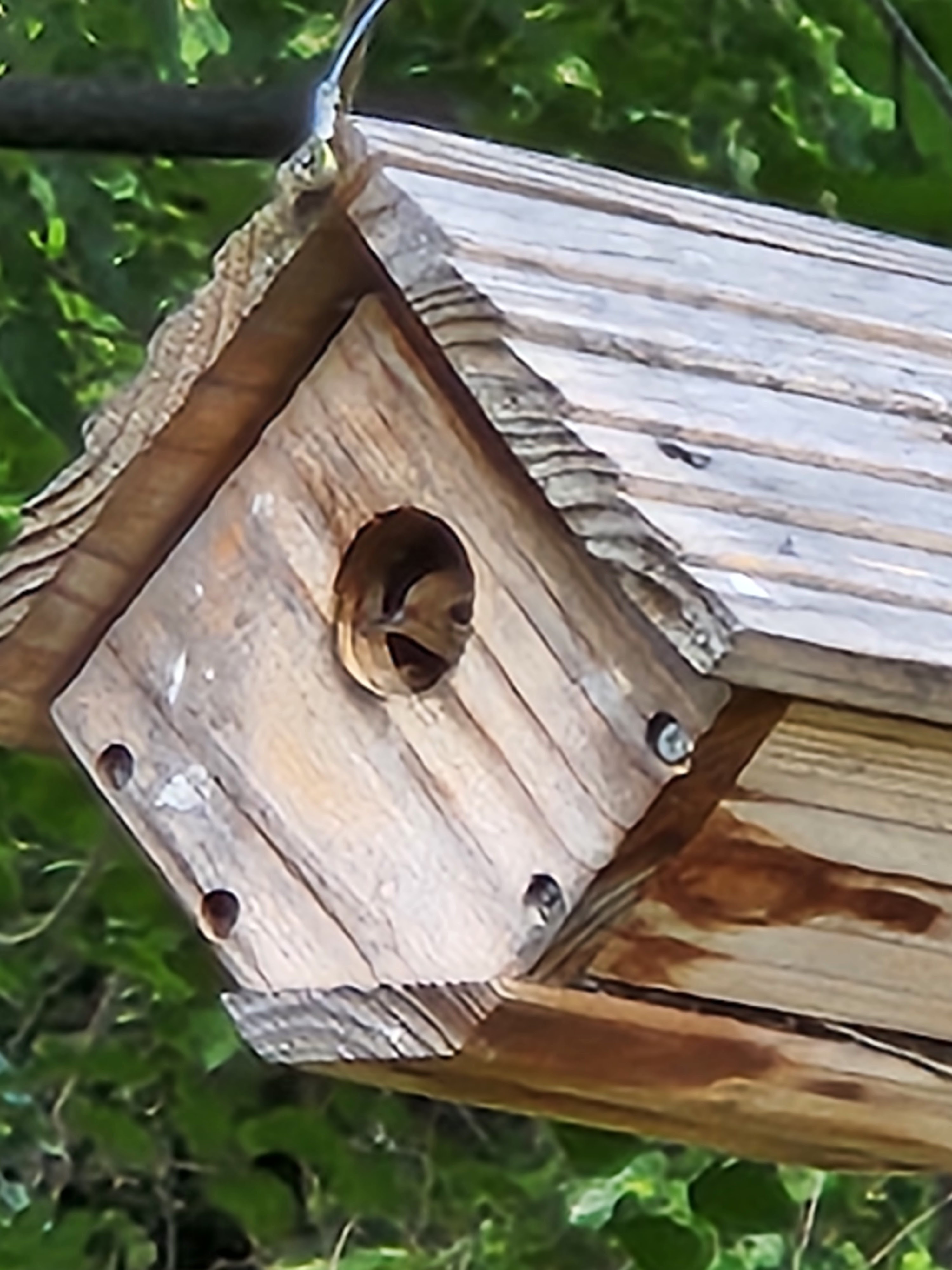
My love of having and observing Jenny wrens began when I was about 10, with my father. He gathered the information about their very particular specific requirements for their houses, etc, and he learned all that with paper magazines and the library, since it was years before the internet. 
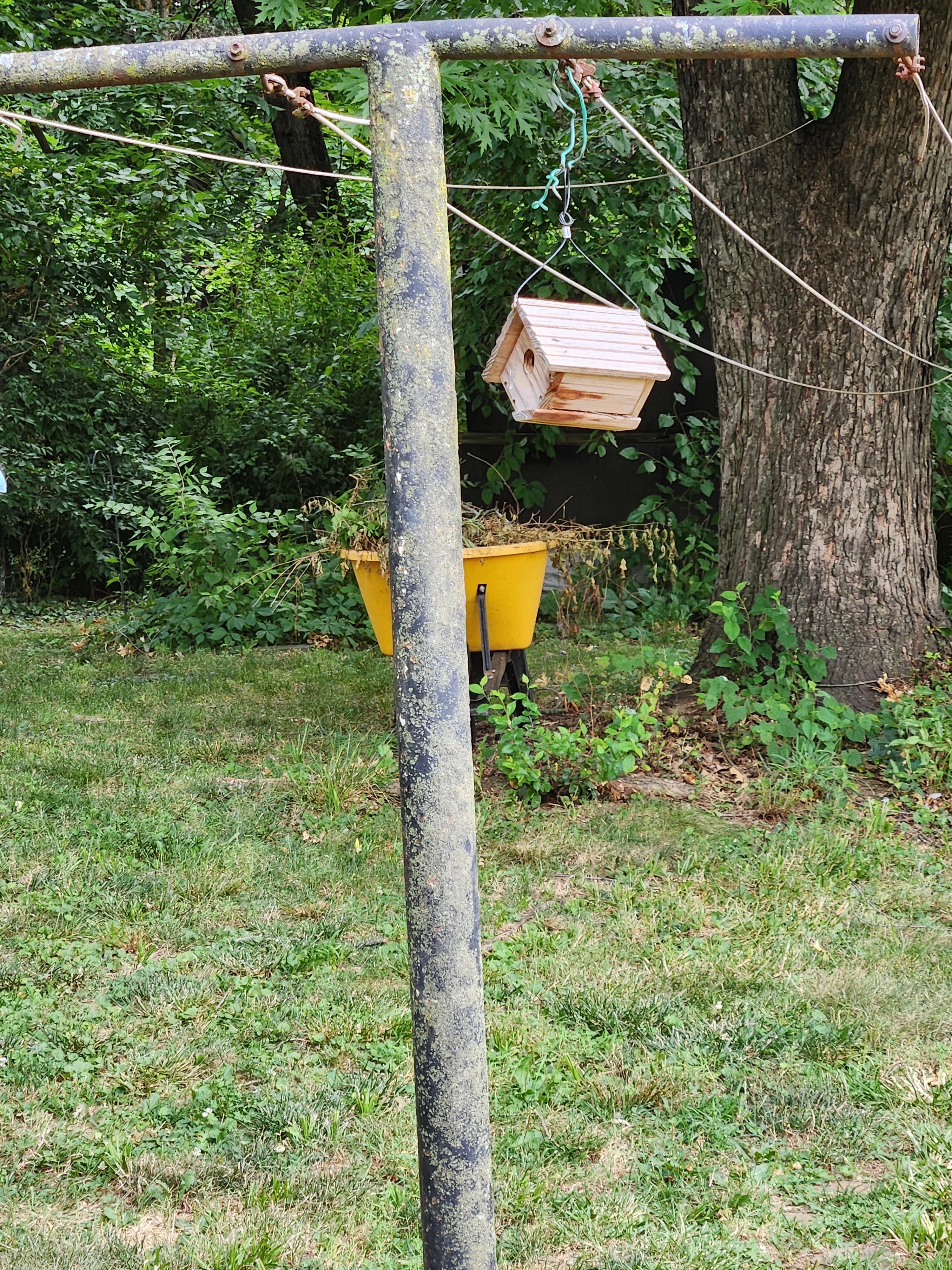
Every spring I hang up 2 wren houses, so she can choose which one she wants.
Then I wait, listening each time I go outside, for that beautiful song to announce: I am here! They fly hundreds of miles from the south to return to the same place each year. Their migration has less to do with keeping warm, and more to do with finding food in a warmer southern climate. There they make a new nest and raise probably 2 clutches of baby wrens. (2 pairs of Carolina wrens stay here all winter. They eat seeds and suet that I give them. Jenny wrens eat only various kinds of insects.)
I wrote a blog about the awful events that happened with their first clutch of the year. All that trauma made me pay closer attention to their activities than ever before. https://sarasinart.net/2024/06/04/a-baby-bird-experience/
Just a week or so after all that, they began to work on a new nest in the bird house. They worked furiously to throw things out of the house; it was funny to see. I could see them carry some things out. At other times there would just be small things fly out of the hole. They wanted to forget the unfortunate memories of before more than I did.
Then they began to build. It’s always fun to watch them building a new nest. They furiously carry in sticks, feathers from other birds, dry grass, etc. Sometimes one of them comes with a stick that’s too long to go thru the hole sideways. Then the bird maneuvers it around to get one end to go in.
They did all this quietly, with no songs proclaiming that this was their territory. That was so unusual; normally their beautiful songs fill my back yard. For tiny birds, they are very defensive and territorial about their bird house and a large area around it. (I have had them actually fly down and pull my hair when I was hanging laundry on the clothes lines. Too close! For a bird that weighs about an ounce to take on a human, wow!) But not this time; they were keeping low profiles after the brutality they went through just a few weeks before.
After a while the nest building was done. Then both birds flew in and out for a few days. Then, one bird flew in all the time with food. One was sitting on eggs and the other was delivering food, taking turns. I can see all this happening and understand it after observing them up close for so many years.
In another couple weeks, I was near the house one day and a wren flew at me with a stern warning, which I like to call growling, bird style. She was telling me I was too close to her house. And then I saw that both birds were flying in with small bugs. Aha, feeding baby birds! Then there was furious work feeding hungry babies, maybe as many as six.
After a couple weeks, there was a day when growling birds were telling me to stay away from the large rose bushes out back. Aha again, some babies have fledged! Both parents tend to the babies for a week or so when they’re on the ground. The babies can fly at first a little, but it’s awkward and not dependable flight yet. The parents guide them into areas where plant growth makes them as safe as they can be, and teach them how to find food and be aware of dangers.
(This whole cycle has to happen very quickly because they need to be ready to fly long distances, with periodic rests, not very long after hatching. Migratory birds have to grow up quick. I use the word furious a lot to describe their activity, because it is.)
I could see and hear that for 4 or 5 days. Now it is quiet, with no small peeping sounds or growling adult wrens anywhere. Other birds are singing, but it’s not the same. The wrens have gone. 
It always makes me sad because I love having these birds in my world. But it’s the natural cycle of life. In a couple weeks, I’ll take down the bird houses and put them in the garage. We don’t clean them out, because they want to do that themselves when they return; they recognize that this was their nest, and that this is their home, again.
After the bad experience with the first clutch, I hope that a pair will come here again next year to fill my yard with amazing bird song, and let me watch them settle in to have another family. They used to come pretty religiously around 5/1, but lately they have come as much as 2 weeks earlier.
So in the spring, somewhere in the middle of April, I’ll get the wren houses out and hang them up, and hope.
 Sarasin's thoughts.......
Very interesting. You mean they leave before the end of summer? Do the young ones return to the same place with the parents or go a different route to find new nests? What would happen if you had several bird houses instead of just two? Would you see more couples?
We don’t know whether all the babies come here and then they sort it out, or how that works. I’ve read that they don’t like to live close to other wrens, too much competition for food.
And they typically leave in July, normally after a 2nd clutch fledges. 2 clutches in one summer is all her little body produces, and all the time they have. They have to get started on a very long journey, and have time to stop to rest along the way, hundreds of miles away.
I love this post. Despite saddening spots, it is beautiful because your heart is shining. Thank you for sharing.
Thanks. It’s an annual thing for me that never gets old.